Ashfield-Colborne Lakefront Association
2025-05-03: ACLA Communications Coordinators meeting summary
If you have suggestions for additional information that you think would be useful in the context of ACLA's mission, you can contact us at info@northwesthuron.com.
[???] ... and if you see that after a date, it means we are guessing. If you know the correct date, please let us know.
ACLA is an unincorporated not-for-profit volunteer "umbrella" organization representing the lakefront and beach associations between Amberley and Goderich in Ashfield-Colborne-Wawanosh Township, Huron County, Ontario. It started as the Ashfield Lakefront Association in 1996 [???] and expanded to include the Colborne lakefront when the three townships amalgamated in 2001. These lakefront areas started as seasonal-resident cottages, although there are a growing number that now include year-round residences.
ACLA coordinates advocacy on the common concerns of the ACW lakefront community. ACLA provides value to the individual lakefront associations by:
Participation in ACLA is voluntary, and free. Each lakefront area is asked to designate a "Communications Coordinator" and one or more alternates. ACLA meetings are held annually, in May on the morning of the Saturday before the Victoria Day weekend. Invited presentations usually include ACW, MVCA, and others.
Over the years, ACLA has:
Through these collaborative efforts, ACLA's activities have helped motivate the creation of the Huron County Clean Water Project and a federal/provincial project called Healthy Lake Huron -- Clean Water, Clean Beaches, established in 2010. HLH is a multi-stakeholder approach to solving complex water-quality issues along Lake Huron’s shoreline from Tobermory to Sarnia. The partnership is led by provincial ministries MECP and AMAFA, and includes federal ministries and other ministries, the area's six conservation authorities, county public health units and planning departments, with input from various non-government and agricultural organizations, residents, and industry.
ACLA's programs are funded by annual contributions from the participating lakefront associations. It is not a requirement for membership in ACLA, but it is very much appreciated because it helps to demonstrate that the lakefront community considers itself a stakeholder in the well-being of our environment.
If your individual lakefront association wishes to contribute, you can do so by "Interac e-Transfer" to aclatreasurer@hurontel.on.ca, or you can do so through Canada Post by cheque using this contribution form.
ACLA does not have registered-charity status. If your association prefers that, the Maitland Conservation Foundation and the Lake Huron Coastal Centre meet that requirement.
Here is a list of the by-laws and regulations that are relevant to lakefront property owners.
Most of ACW's lakefront seasonal properties are subject to Ontario's regulations for development within the 100-year erosion line of the Lake Huron shore and bluff. For details, see MVCA shoreline and gully maps and regulations.
The Lake Huron Coastal Centre offers a number of community programs and has many guides that are of particular interest to lakefront property owners.
Pollution that affects the lakefront community is an on-going concern. DNA analysis of tests done by ACLA in 2003 showed that the E.coli source is animal, not human. The results of ACLA's annual stream-testing program since then show that the dominant cause is untreated run-off from agricultural activities. This was clarified in a UoGuelph/MOE DNA-analysis research report published in 2009, conducted in 2005/2006 around 18 Mile River, which confirmed that the sources of E.Coli were 59-62% livestock/manure run-off, 16-18% persistent swash-zone E.Coli, 5-14% wildlife, 2-3% human, and 8-16% unquantifiable mixed sources.
Through its lakefront environmental strategy, ACLA works to reduce the effects of agricultural runoff. These efforts led to the creation of the Healthy Lake Huron program to promote safe and clean beaches from Sarnia to Tobermory. Five key watersheds were identified as priorities for immediate action. Program staff work with local partners to develop and support the implementation of watershed management plans, with specific targeted actions, as well as monitoring and research needs, for each priority area. The priority in our area is the Garvey-Glenn Project. For more information, see the HLH reports.
Ontario's Clean Water Act is intended to keep contaminants from seeping into the sources of our drinking-water lakes, rivers, and aquifers. The Ausable Bayfield Maitland Valley Drinking Water Source Protection Committee is responsible for developing proposed policies for our area. Huron County also has a number of related water-protection programs.
ACLA has been urging this since 2002. In 2005, the Huron County Health Unit initiated a voluntary re-inspection program, and inspected 174 properties in 2005 and 178 in 2006. In 2010, HCHU proposed a mandatory inspection program, but the program failed to get support from enough of the nine municipalities.
With the 2020 merger of the Huron and Perth health units to form Huron Perth Public Health, responsibility for approval of septic systems shifted to ACW under the Chief Building Official. In 2024, ACW initiated an on-going septic inspection program.
Back in the 1980s [???], the Huron County Health Unit began measuring pollution levels at all public and some test-case beaches from June through August. This is now performed by the merged Huron Perth Public Health organization.
Levels can change from day to day. E.coli levels are closely related to whether rainfall has recently carried pollutants from inland via the streams, and whether the water has recently been churned by wave action. If you are in the lake up to your waist and cannot see your feet, it is not advisable to be in the lake that day.
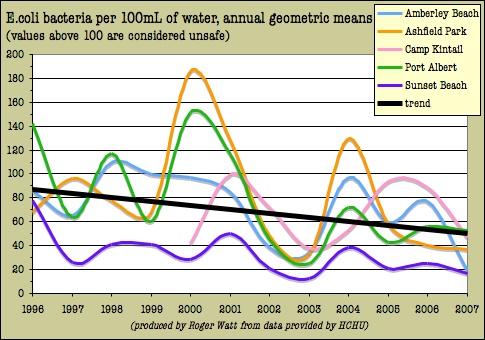
The HPPH website contains recent reports. For 2000-2007, we thank the former HCHU for providing the data from which we compiled the summaries for 2008-2012, 2007, 2006, 2005, 2004, 2003, 2002, 2001, 2000, and this trend-line graph.
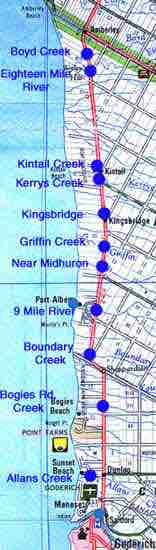
In conjunction with MVCA, ACLA conducted water-quality tests for a number of years to help identify the inland sources of contamination (see location map) ... 2014 2013, 2012, 2011, 2010, 2009, 2008, 2007, 2006, 2005, 2004, 2003, 2002, 2001.